
A note on the post title - in Africa amongst those who know Meag, I was referred to mostly as Meagan's 'stranger,' such as "Ah, your stranger! How are you?" I was never really sure if the use of the word stranger was meant to convey anything specific, but it seemed friendly enough, so Meagan's stranger I became.
The story of my week - likely a very condensed version of the story of Meag's seven weeks - is one of observation, questions and ultimately satisfaction in a truly interesting experience.
Stepping onto the Banjul airport tarmac for the first time, the first thing one notices is the heat. 98 degrees (Fahrenheit) and humid. The Brit next to me comments that he 'is already sweating,' though I think he was sweating on the plane, so that's not really saying much. But hot it is.
Herding into the terminal, which seems to be a monument to the Jammeh Administration (in power since a 1994 coup), one is immediately struck by the Gambian military presence. There are men with guns everywhere. I braced myself to be hassled a bit by the passport/visa clerk; she did not even look at me as she took my passport, stamped it and waved me into Africa.

The baggage claim process took a REALLY long time. I learn throughout the week that, unlike we Americans, who tend to take pride in our drive to expedite everything, Gambians operate with a bit more deliberation. I grab my backpack and walk confidently through Customs - again without hassle from the machine gun-toting military guys (I consider a smile and a nod as I pass, then decide not to tempt fate - instead going with the solemn, straight-ahead stare of a man who knows where he is going). Visible through the exit doors at this point - the long-lost, friendly face of one Meagan Basilius!
We exit the airport and make way to our waiting driver and transport (a pickup truck belonging to the National Beekeepers' Association, for use by Mondo volunteers when not in use for carrying bees and honey), which carries us to the coastal town of Fajara. En route, as Meag fills me in on where we are and where we are going, I am struck by how well she has gotten her arms around this very foreign place in her short time here. Not surprising - you all know Meag - but both impressive and, in that moment, comforting.
Our first two nights are spent at the Leybato Restaurant/Hotel in Fajara. Having been to the restaurant a few times before (its private tables are right above the beach, overlooking the waves), Meag knows the proprietor and most of the staff. Our room is clean enough and affords the constant sound of ocean wind and waves. There is a mosquito net above the bed - a reminder of the ever-present (though less so in the current, dry season) threat of malaria. A couple of pics from our hotel:


Fajara is in the middle of a few small tourist enclaves. Like other touristy places around the world that are surrounded by relative poverty (think Costa Rica or Mexico), it has its share of locals trying to extract as much tourist wealth as they can. Sadly for the sake of cultural exchange, the intensity of those trying to sell you things or get Meag to marry them is very high. After the fifth or sixth thirty-second dialogue that ends with a firm 'we're really okay, thanks,' you find yourself striving not to connect with anyone you pass.
The Gambia is the one of the poorest countries in the world, with an average annual income of about 8,000 Dalasi ($400 US), and the contrast between haves and have nots is most transparent in the tourist areas. This is a source of fairly regular discussion between Meag and I during my week there. Our hotel for those first two nights, while by no means fancy, is 1,000 Dalasi per night. Even something as simple as a Coke - a mere 50 Dalasi - is a significant luxury for most Gambians. Without getting into the obvious series of thoughts and questions that this raises in the mind of the concerned visitor/volunteer, we do spend a fair amount of time thinking about what defines a good life and being thankful for that which we take for granted back home. Whether or not our relative wealth and materialism makes for a better life, the shrinking world brought about by the internet and satellite TV leads Gambians (especially young Gambians) to think that they want everything that we have. In some ways I want to read them all some Thoreau ("Simplify, simplify, simplify!") and explain that there is a downside to our materialism, but that too seems presumptive. Anyway, I said above that I was going to avoid the unending, circular discourse in which this always seems to terminate, so let's move on.
On Sunday morning (day three of eight for me), we have breakfast at Leybato (included with our room - hard-boiled eggs, french bread and butter, jam, orange juice, nescafe) and hire a taxi to take us to Makumbaya (Meag's village - about 45 minutes away). The taxi-hiring process is similar to all significant purchases in The Gambia, in that it is all about the barter. Every bartering experience involves some amount of guilt, as we consider how much more the money means to the person selling the good/service than it does to us, and hope that the seller is smart enough to price the good/service such that they are actually making a profit. Ultimately, we talk the driver down from an initial offer of 600 Dalasi ($30) to 300 Dalasi ($15) to take us to the village. Interestingly along the way, it becomes apparent that our driver is not exactly sure where Makumbaya is located. Meag knows most of the turns from her gellah gellah experiences, but it not 100% sure either. After a few seemingly random turns into dirt alley-ways (all ultimately correct) and a couple of stops to consult with locals, we reach our destination successfully.
Makumbaya feels like 'real' Africa, and is a series of compounds (a couple of buildings with a big yard and, usually, a fence or wall along the adjacent dirt road/path) that total maybe 500 people. In the center of town there is a mosque, a market (where one can purchase fish and chicken and vegetables) and a small store that sells assorted, often canned sundries. Additionally, as noted by Meag in previous posts, there are farm animals everywhere. A few pics:


As we walk through the village towards Meag's compound, it is apparent that she has built rapport with Makumbaya's residents, as everyone is excited to see her and her 'stranger.' Also, there is much discussion of the state of the nursery project, which (again as noted by Meag previously) is on hold today due to two deaths in town. As we stop to talk with the carpenter and the man coordinating the masons and the artist, I note how well Meag keep things moving forward ('so, can the masons work tomorrow and Tuesday?') while respecting Gambian pace and culture. It is also apparent that those involved in leading the project on the Makumbaya side really respect her presence and appreciate her focus on getting the work completed. A few pics that Meag has taken of the nursery and the work so far (ALL pics available on my flickr site - see link below):


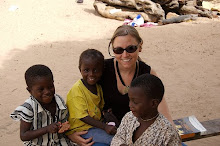
Meag's compound seems to be about average for the village. While there is no abundance of anything (many mouths to feed and only a few people working outside the compound), everyone generally seems happy and healthy and well-fed. The children LOVE Meag. As she has noted previously, the adults generally do not seem to give the kiddos too much attention, other than yelling at them occasionally in the local language. Meag is especially taken with Fatou Saar, who has an infectious smile and giggle. Everyone is also excited to meet me ("Joyson! Joyson!"), which is very nice. A few pics and videos of the compound's residents, including Meag's beloved Fatou (if you look at all of the pics on flickr, you will note that there is no shortage of Fatou pics):


Jeneba (one of the women of the compound and one of its few fairly fluent English speakers) made a special meal for Meag and I (really delicious, though aside from chicken and rice, I have no idea what it was), and I had the opportunity to meet Ebrima (compound owner, Mondo Gambia Country Manager and a really nice man), have attaya and sweet milk and play with the kiddos. Meag noted that, aside from the disappointment of not getting anything done with the nursery, it was nice that I saw a pretty typical compound day - lots of sitting and talking and taking life in. A few more pics:


The next morning, we went to Meag's school, where she taught a jolly phonics lesson and gave a spelling test to one of her sixth grade classes. As the classroom observer and spelling test grader, I observed a few of Meag's comments first-hand: The kids are very respectful and enthusiastic to learn, but their skill level is all over the board, with some obviously getting the material pretty well (though not perfectly), and some way, way behind. The high scorer was obviously very proud of himself when recognized by Meag - similar to the way the adults of Meag's compound interact with the children, I am not sure that parents and others at home reinforce doing well in school, so the kids seem to respond well to Meag's encouragement. A few pics from Makumbaya Basic School:


After leaving Meag's school, we hopped on a gellah gellah to Brikama. The ride made me remember that my legs are very long. In Brikama, we went to Meag's tailor to pick up some African outfits that she had made, then went and purchased some fabric and got one made for me. We also stopped at a busy Internet cafe, where Brikama youngsters were excited to talk with me about America and give me their email address so that 'maybe we can become friends.' Brikama is very much the non-touristy Gambian city, and was very interesting to experience (albeit very hot). Pics from Brikama:


Finally, late in the afternoon we took a bush taxi to what turned out to be our final place of lodging - the Sandale Eco Resort. Unbeknownst to us, it is not actually open yet (construction continues) but has a few lodges open for guests who don't mind a (very nice) work in progress. I could go on and on about Sandale, but will summarize here: On the south Gambian coast near the town of Kartong (recently connected to the rest of The Gambia via paved road), Sandale is meant to represent the future of sustainable, locally beneficial tourism. Its employees are nearly all Kartunkas (residents of Kartong), it shares its profits with the village, and, while currently owned by a British couple (Morris and Jerri - super-nice, inspiring couple), ownership will pass to the village in 25 years. In addition, it is truly eco-friendly (no green-washing here) - solar-powered electricity and hot water, all local materials, limited cement (cement production contributing 10% of all carbon dioxide emissions world-wide), local food, sustainable timber - I could go on and on. Truly impressive. As it turned out, it was also even more luxurious than it is supposed to be - for our last three nights, we were the only guests, meaning that the entire staff was focused only on us (a little uncomfortable at times for two people not used to being 'served'). Upside on the individual attention was the ability to really get to know and converse with the staff, learning about their lives and their hopes for the future. A few key learnings: (1) While each is paid relatively well (1,000-2,000 Dalasi per month), they often have to support 15-20 men, women and children in their compounds, so their earnings do not go very far (a bag of rice for 6-8 runs 700 Dalasi per month); (2) From an ethnicity perspective, they tend to identify more with their tribes than with the nation of The Gambia (recall that the African states were defined by the colonizing nations in line with their interests, in most cases bisecting the true form of African organization, the tribe); (3) While nearly everyone with whom we spoke would like to be more sustainably wealthy than they are, they do not tend to think in terms of goals the way we westerners do, so questions about how they are going to accomplish that (invest in a business, irrigation wells and ditches for their land, etc.) tend to be met with little/no response; and (4) Consistent with that which we've read about Gambian culture, they place extremely high value on relationships and the well-being of family and friends.
Pics from the very relaxing Sandale and the nearby village of Kartong (including a scheduled football-viewing event featuring the hometown football club of a London friend):


So that is my Gambian experience. As I hopefully conveyed a bit in my musings above, The Gambia (like most of Africa, I imagine) presents many contrasts that cause one to think through big-picture issues. I feel very fortunate for the exposure and the experience - truly life-enriching and perspective broadening.
I close with a couple of pics of Meag and I and a couple of pics for my full-moon-appreciating friends in Santa Cruz; the link to our set of Gambia pics on my flickr account is below that. Thanks for reading and hope this finds you well.
Jason


http://www.flickr.com/photos/jasonjschultz/sets/72157604212276292/
